Trunk or treat gets talked about as the thing you do when the weather’s bad, or the neighborhood isn’t safe, or you couldn’t be bothered with the real version.
That’s backward. It’s the better-designed version, and for a lot of families it’s the only one that works at all. Not because it’s easier, but because it removes obstacles that traditional trick-or-treating never bothered to consider in the first place.
What Trick-or-Treating Actually Requires
Nobody lists the requirements because, for most people, they’re invisible. Write them down, and it’s a fairly demanding evening.
Distance.
A decent route is a couple of miles of walking, done in the dark, at the end of the day.
Stairs at nearly every stop.
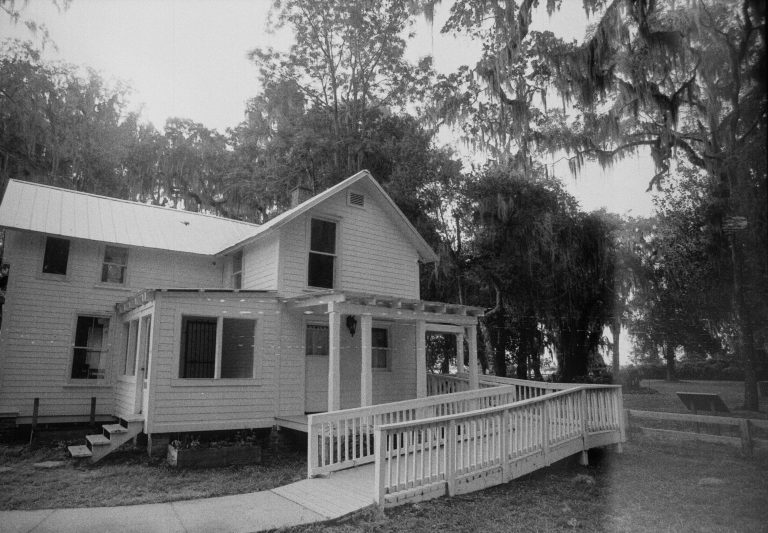
Front doors sit above ground level almost everywhere. One step, three steps, a porch. Multiply that by forty houses.
Terrain between the stops.
Driveways with a lip at the bottom. Lawns. Gravel paths. Cracked sidewalks, or in plenty of neighborhoods, no sidewalks at all, which means being in the road.
Darkness, which is worse than it sounds.
It isn’t just that the ground is uneven. It’s that you can’t see what you’re maneuvering around. Cracks, tree roots, a lip you’d have spotted at noon, a dropped bucket, a curb that arrives sooner than you expected. Everyone else is watching for cars. You’re watching for the four inches in front of your casters, in the dark, while also keeping track of a child.
The sidewalk becomes a game of chicken.
Kids move erratically and at speed. Strollers take up the width. Groups stop dead without warning. And you are the least maneuverable object in a crowd of the least predictable people, in the one setting where the stakes are asymmetric, because a collision that’s nothing to an adult knocks over a four-year-old. You can’t swerve. They can, and won’t. Depending on the costume, you may find yourself playing chicken against an actual chicken.
Unpredictability.
You don’t know which houses are participating, which have a dog, which have a motion-activated screamer on the porch, or which will have someone who wants to talk about your kid’s chair.
No bathroom, anywhere, for two hours.
Enough said.
And the weather does whatever it wants.
Late October, after dark, standing still repeatedly, in a costume that was designed for a photograph rather than for cold. If you can’t move enough to generate heat, or your circulation doesn’t manage cold well, an evening outdoors stops being a beloved tradition somewhere around house eleven and becomes something you’re enduring in front of your children.
Every one of those is trivial if your body handles it without thinking. Each one becomes a decision point if it doesn’t.
What Trunk or Treat Does Differently
Here’s the argument. Trunk or Treat doesn’t accommodate those problems. It structurally doesn’t have them.
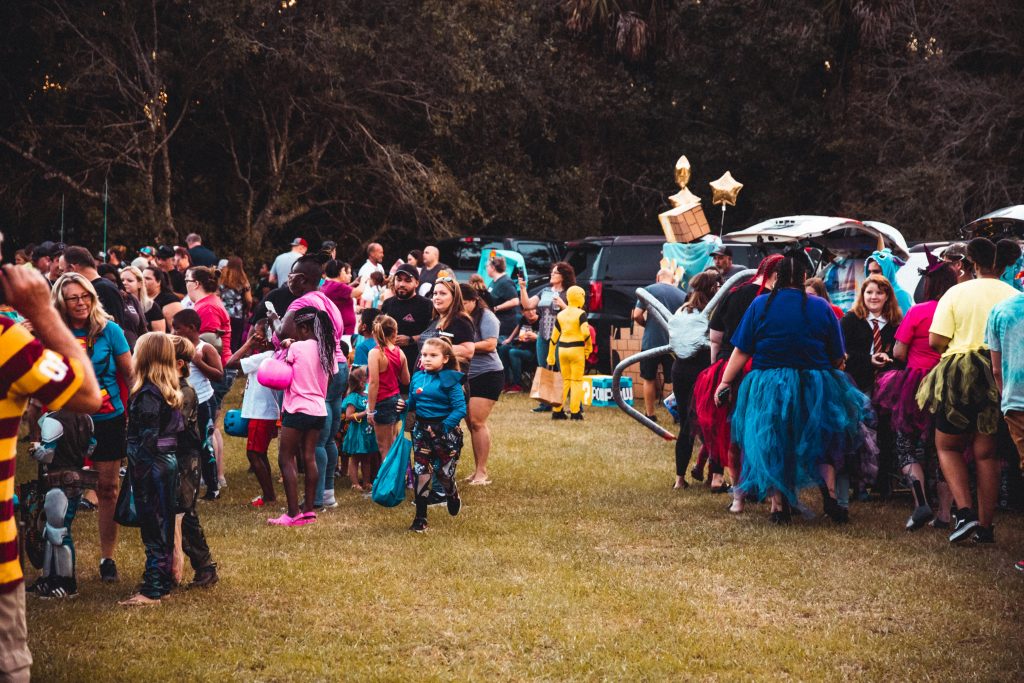
It’s in a parking lot. Flat, paved, and built to be crossed. No curbs between stops, no lawns, no gravel, nothing to catch a caster.
The stops are twenty feet apart. A full circuit is a fraction of the distance of a neighborhood route, and you can stop whenever you want without abandoning the whole thing.
An open trunk is at seated height. This one matters more than anything else on the list. At a front door, the candy is in a bowl held by a standing adult, above a kid in a chair, at the top of a step. At a trunk, it’s right there. The child takes it themselves. Nobody has to reach down, nobody has to be handed something, nobody has to wait at the bottom of a driveway while somebody else collects for them.
Somebody planned the lighting. This is underrated. A trunk or treat is a deliberately lit event, and most of them run in daylight or early evening rather than after dark. That solves the seeing problem, the being-seen problem, and the fact that late evening is when energy has already gone.
The crowd behaves differently. People move between cars in a loose queue rather than surging along a corridor; there’s room to pull to one side, and everyone is moving at roughly the same slow pace. It’s the difference between a sidewalk and a market.
You can see the whole thing. The event is bounded. A parent knows where their kid is, how much is left, and when it ends. That’s an enormous difference for anyone managing anxiety, their own or their child’s.
Everyone there is participating. No wondering which cars are handing out. No dark houses. No dogs.
There’s usually a building attached. Trunk or treat runs at churches, schools, and community centers, which means a bathroom, warmth, and somewhere to sit down for ten minutes when the weather turns.
And you’re standing next to your car. If it stops working, you leave immediately.—now walk home in the cold.

The Half Nobody Writes About Is the Parents
Every article about accessible Halloween assumes the disabled person is the child.
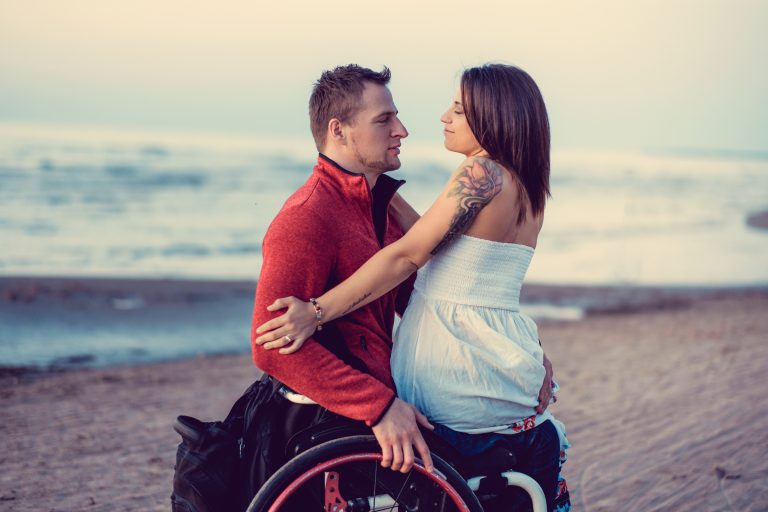
A disabled adult can’t walk a two-mile route either. And the specific difficulties of doing Halloween as a disabled parent almost never get named.
You can’t get up the driveway your kid just ran up, so you’re supervising from the road. You can’t reach the door to say thank you, or intervene if a conversation goes badly. If you use a manual chair, you need both hands to propel, so you can’t carry the bucket. You’re covering the same distance they are, in the cold and the dark, for two hours, after a full day.
At a trunk or treat,t you’re beside your child the entire time, on a flat surface, in a bounded space, near your car.
And there’s a version of it that changes the whole night. You can host a trunk. Instead of escorting from a distance, you’re the destination. Your kid runs the lot and comes back to you. Other people’s kids come to you. You’re at the center of the event rather than trailing it, and the entire logistical problem inverts.
I’ve never seen that suggested anywhere, and it’s the single best answer to Halloween I know of for a disabled parent.
The Part About Dignity
There’s a version of accessible trick-or-treating where the child gets carried up the steps. Or waits at the curb while a sibling collects for them. Or where a well-meaning adult comes down the path, crouches, and makes a small performance of it while the queue behind watches.
All of that is kind, and all of it marks the child out.
At a trunk, a kid in a chair does exactly what every other kid does, in the same way, at the same height, with nobody adjusting anything. That’s not a small thing. Doing the ordinary version of an ordinary childhood activity is most of what inclusion actually means.
It Isn’t a Consolation Prize
Worth saying, because there’s a snobbery about this.
Fifty thousand people a month look up trunk-or-treat ideas. Communities run them because they’re safer, warmer, shorter, better lit, and easier to supervise. The accessibility isn’t a compromise somebody made for disabled families. It’s a side effect of a design that’s simply better for a lot of people at once.
Which is what universal design looks like when it works. Curb cuts were built for wheelchairs and are used by everybody with a pushchair, a suitcase, or a delivery trolley. Nobody calls those the lesser pavement.
Making It Work as a Family
Go early. The first thirty minutes are quieter, less crowded, better lit,t and easier to move through.
Do a lap first without stopping, so you know the layout and where the gaps are.
Costume over equipment, not around it. A chair is a chassis. Decorating it is far easier than working a costume around it, and it usually looks better.
Put lights on the chair. Parking lots are dark, and drivers are moving through them. Wheel lights are a Halloween accessory that happens to be a safety measure.
Dress for standing still, not for walking. Costumes assume movement generates heat. If yours doesn’t, the layer underneath matters more than the layer on top.
Decide the exit in advance. One lap, or thirty minutes, or when it stops being fun. Knowing the end point makes the whole thing easier to enjoy, and the energy arithmetic is real whether you’re the kid or the adult.
The Night That Actually Happens
The objection is that it isn’t real trick-or-treating. No neighborhood, no doorbells, no wandering.
Which is true, and beside the point. For a substantial number of families, the real version isn’t a night that goes badly. It’s a night that doesn’t happen. A child watches from a car, or stays home, or does three houses and stops.
An hour in a lit parking lot where your kid does exactly what every other kid does, unassisted, at the same height, is not a lesser Halloween. It’s the one they’ll remember, because they were in it rather than beside it.
Tips for Making Your Trunk or Treat Event Truly Inclusive
I turn up to these as two people at once. One of them is a wheelchair user reading the ground. The other is a mother watching a child. They notice completely different things, and events tend to be planned for neither.
Here’s what each of them sees.
Publish the access information before the day.
This is the one almost nobody does,s and it matters more than anything else on the list. The decision about whether to come gets made days earlier, at a kitchen table, while a parent works out whether it’s worth loading everyone into the car. Put the surface, the lighting, the bathroom, om and the parking in the event listing. A family who can’t find out will assume the answer is no.
Leave real space between the cars.
As the chair user, I need room to turn around, not just to pass through. As the parent, I need to be beside my child rather than stuck behind them in a queue. Bumper-to-bumper parking makes both impossible.
Walk your route looking down.
Potholes, gravel edges, drainage grates, speed bumps, and the strip of grass everyone cuts across. I’m scanning for what will catch a caster. My kid is running and not looking at all.
Put the bowl on the bumper.
Not held at adult chest height. When a child can reach it themselves, they’ve done the thing rather than been handed it, and I haven’t had to intervene. Both matter more than they sound.
Don’t park in the accessible spaces.
Events use them as staging constantly, and it fails before anybody gets out of a car. If a van can’t deploy a ramp, that family goes home without ever reaching your event. Keep the route from those spaces clear too.
Light the gaps.
Parking lot lighting comes in pools with dark patches between them. I need to see the ground. My child needs to be seen by whoever is still driving through. Both of those problems live in the same dark patches.
Signpost the bathroom and check the route to it.
My kid will need one. So will I, and mine takes longer and needs more room. A single step between the lot and the door undoes the whole event.
Run a quiet window at the start.
Half an hour with no sound effects, no strobes,s and no jump scares. That’s for the children who’d otherwise not come, and it’s also for their parents, because a child who becomes overwhelmed at seven ends the evening for everybody with them.
Put chairs out
For anyone who needs to stop without leaving, for grandparents, and for the parent who’s been upright since six in the morning.
Check your costume contest stage.
If it has two steps, a child in a chair can’t be judged on it, and every single person there will notice. A flat area works exactly as well.
Do the teal pumpkin thing.
FARE’s Teal Pumpkin Project asks you to offer non-food treats in a separate bowl and signal it with a teal pumpkin or a printable sign. It began with food allergies, and FARE’s own description extends it to other conditions, which covers kids with feeding tubes, restricted diets, and anyone for whom the candy isn’t the point.
And have somebody who can answer questions.
Not a policy document. A person who knows where the accessible bathroom is and whether the surface is smooth. Families will ask, and “I’m not sure” is the answer that sends them home.