I walked down the aisle at my first wedding. (team #secondmarriages)
The aisle was a beautiful yard with grass and uneven ground that was not the easiest for someone who was barely able to walk anymore. But damnit, I was determined to have my moment. I walked down the aisle, stood for the ceremony, walked back up the aisle, and posed for photos for another hour on my feet. Then walked into the reception hall onto the dance floor.
About thirty seconds into the music, I fell. The room went silent in an instant, while I fell into a cloud of beaded corset and white poofy satin. I panicked. I laughed. My at-the-time husband scooped me back up, and we continued.
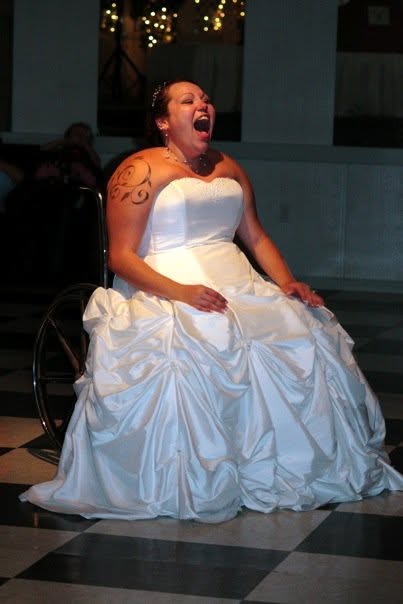
And as soon as the song ended, my cousin walked my manual wheelchair over to me and said, “Sit.”
I listened.
I spent the rest of my wedding celebration in my manual wheelchair. Not because anything had changed between four o’clock and eight. Because walking had cost what walking cost, and the chair was the difference between staying at my own reception and going home.
Same person, same day, both states. Nothing about that was a contradiction, and nothing about it was faked.
That’s what an ambulatory wheelchair user is, and it’s why it’s the most argued-about identity in the disability community.
The Definition, Quickly
Ambulatory wheelchair users are, plain and simple, people who can walk but also needs ot use a wheelchair. There are a variety of reasons and situations for this. The chair may not be needed all the time, but it can be the deciding factor in how far, how long, and how safely a person can move throughout the day.
It’s a community term rather than a clinical one, which is why you won’t find it in a medical chart. Clinicians write about gait limitations, partial mobility,y or assistive device use instead. That doesn’t make it less real.
The Moment Every Part-Time User Knows
You stand up to reach something on a high shelf, or take four steps to a restaurant booth, and you feel the room reorganize itself around you.
Sometimes what follows is delight. Sometimes it’s a comment that you don’t really need that. Occasionally it’s a photograph taken without permission, or a note left on your car.
It’s Far More Common Than People Assume
This is the part that surprises people, and it’s the reason the assumption underneath the arguments is simply wrong.
Federal disability data has never treated mobility as a binary. When the Census Bureau measures it, the American Community Survey asks whether a person has serious difficulty walking or climbing stairs. Not whether they can walk. The official question is about difficulty, because difficulty is what shapes a life.
Roughly 7 percent of Americans report an ambulatory disability of some kind. Only a fraction of those people are unable to walk at all. Independent living organizations working with this population, including Paraquad’s piece on misconceptions about part-time wheelchair use, make the same point: full-time non-ambulatory use is one version of wheelchair use, not the definition.
Which means the person standing up out of a chair in a parking lot isn’t the anomaly. The assumption is.
Why Someone Who Can Walk Uses a Chair
The reasons are specific, and almost none of them are about whether standing is physically possible.
- Pain. Walking is available and costs more than it’s worth, and the bill arrives for days afterward.
- Fatigue. Energy is finite. A chair buys back the hours that would otherwise go to recovery.
- Distance. Twenty feet is fine. An airport terminal isn’t.
- Falls. Balance problems, foot drop, and sudden weakness make walking genuinely dangerous, and one bad fall changes everything.
- Symptom triggers. For some conditions, being upright is the problem. Standing still is harder than walking, and both can cause fainting.
- Unpredictability. When function swings without warning, a chair is insurance against being stranded with nothing left.
Every one of those is a version of the same thing. Walking isn’t impossible. It’s expensive, and the person has decided to spend that money somewhere better.
I’ve Been on Both Sides of This
I started transitioning into a wheelchair in my early twenties.
For a while my life ran on a very specific set of rules. Manual chair for anything outside the house. But I’d walk to my car to drive, and walk from the car into my college classes. If you’d watched me in the parking lot, you’d have seen a woman walking. If you’d watched me an hour later at the mall,l you’d have seen a woman in a wheelchair. Both were true. Neither was the whole picture.
And here’s the part that still makes me laugh. When I could walk, I walked barrel-backed, with my spine curved and my stomach pushed forward, because that was the only way my body would hold itself upright. So nobody thought I was disabled at all.
They thought I was pregnant. Constantly. Strangers congratulated me. People asked when I was due.
That’s the flip side of this argument,t and it rarely gets discussed. It isn’t only that people accuse you of faking. It’s that when your disability doesn’t look the way they expect, they will confidently substitute an explanation that makes more sense to them, and then act on it.
I use a powerchair full time now. What I want to say from here is that part-time users aren’t taking anything from the rest of us. No fixed quantity of accommodation gets diluted when more people use chairs. The ramp doesn’t get steeper. The accessible stall doesn’t shrink.
What actually costs full-time users is the belief that a wheelchair has to be earned through total loss of function. That belief is the reason people spend years hurting themselves to avoid one, and it’s the same belief that has strangers deciding who qualifies. It doesn’t protect anybody. It just makes the gate narrower for everyone standing at it.

The Three Reactions
Ask any part-time user and the same three responses come back.
The miracle. Delight, congratulations, comments about progress that never happened. Well-meant and exhausting, because it requires you to correct a stranger about your own prognosis.
The suspicion. A look, a muttered comment, a conversation that stops when you approach. The most common and the hardest to answer, because there’s nothing concrete to respond to.
The report. Someone complains to staff. Someone photographs you. Someone leaves a note on your windshield. This is the one that costs money and time.
Where It Actually Does Damage
The moments in parking lots are the visible version. Here’s where it has consequences.
Parking. People love to play superhero when it comes to accessible parking spaces. My (current) husband was once screamed at by an older gentleman when he ran out to our van, parked in a handicapped spot, to retrieve something. I was rolling around the store, completely oblivious to the situation. Placard holders who walk from the space get confronted, reported, and occasionally have their vehicles damaged. A doctor issued the placard. The person confronting you has assessed nothing.
Airports and airlines. Requesting a chair and then being seen standing at a gate gets treated as suspicious by staff who have decided what disability looks like. People get asked to prove they need assistance they’ve already been assigned. Knowing your rights before you fly with a wheelchair is a huge part of a smooth process here.
Work. An approved accommodation gets quietly re-litigated once a colleague sees you stand up. The chair becomes something you’re suspected of rather than something you use.
Disability benefits—the most consequential one. Being photographed or observed walking is a genuine fear for people receiving benefits, and it shapes behavior in ways that make life worse. Worth knowing that the Social Security definition of disability turns on your ability to sustain substantial work, not on whether you can take steps. Understanding how disability claims are evaluated matters here, because the standard focuses on function over time rather than any single moment somebody might witness.
Online. Part-time users who post about their lives get accused of faking for attention, in volumes that push people off platforms entirely.
What the Law Actually Says
You owe strangers nothing. You are not required to produce a diagnosis, a doctor’s note, or a performance of suffering to justify equipment you use.
When the challenge comes from a business rather than a bystander, the position is clearer still. Under the Americans with Disabilities Act, businesses and state and local government facilities must allow people with mobility disabilities to use wheelchairs anywhere the public is allowed to go, and the ADA National Network’s fact sheet on wheelchairs and mobility devices sets out how narrow the exceptions are.
Staff does not get to evaluate whether you look disabled enough for the chair you arrived in.
People do report other people for this, and it’s almost always baseless. A parking placard was issued by a clinician, not by whoever is watching you cross the lot.
The Cost Nobody Counts
The damage isn’t hurt feelings. It’s delay.
People who would benefit from a chair right now put it off for years. They absorb pain, give up work, drop out of school, stop seeing friends, all because they’ve internalized the idea that using one before they absolutely must would be dishonest. By the time they give in, they’ve often lost conditioning, income, and a good part of their world for no medical reason whatsoever.
That’s what the suspicion actually produces. Not fewer people faking. Fewer people getting help.
And the weight of being questioned is its own thing, particularly when your condition is already unpredictable. The relationship between disability and mental health gets discussed as though it’s all about the body. A lot of it is about being disbelieved.
What to Say When Someone Questions You
Have a few responses ready, so you aren’t composing one under pressure.
- For a stranger: “It helps me get around.” Then stop. A flat, friendly non-answer ends most of these faster than any explanation.
- For someone you care about: “I can walk a little, and the chair means I can do more, not less.” Most people who ask badly are asking honestly.
- For a repeat offender: “I’m not going to discuss my medical history.”
- For a business: Ask for a manager, and know you’re on solid legal ground.
You don’t owe anyone the long version. The long version turns a two-second interaction into a ten-minute defense of your own body.
If You’re Considering a Chair Part Time
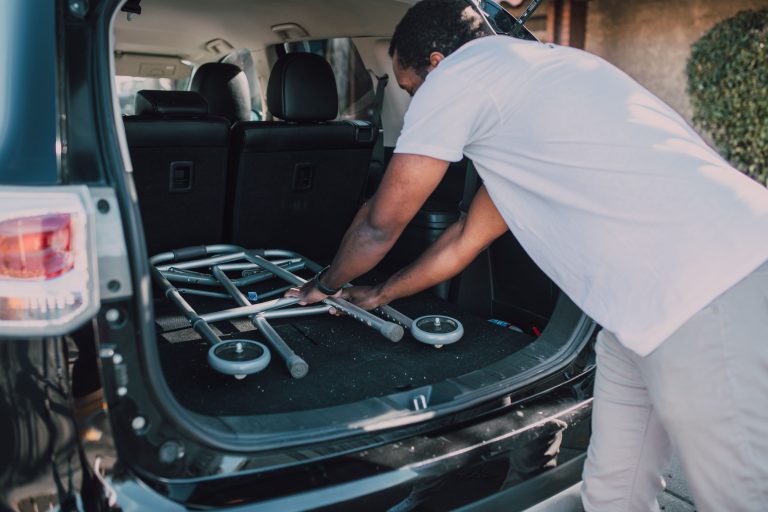
You don’t need permission to try. Renting for a trip or borrowing from a local loan closet costs little and tells you a great deal. Many communities run lending libraries through independent living centers.
Get a seating assessment before you buy. A chair that fits poorly causes pain, poor posture,e and skin problems. That matters more when use is occasional, and the chair spends time in a car trunk.
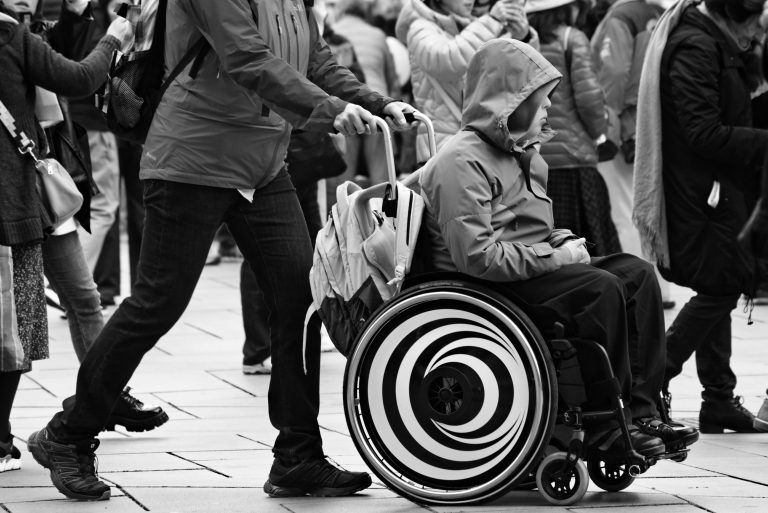
Think about who’s pushing. If fatigue is the main issue, self-propelling can defeat the whole purpose, and power assist may be the better answer even for occasional use.
Using a chair won’t make you weaker. This is the fear that keeps people out of chairs the longest, and it has the logic backward. Conserving energy on transportation leaves more available for everything else, including movement you actually choose.
The Point
A wheelchair is a mobility device, not a verdict. It’s measured by what it lets someone do.
I got to stay at my own wedding reception because I had a chair to sit in. That’s the whole case. A chair used twice a week for the grocery store and the airport is doing its job perfectly, and the person using it doesn’t owe anyone in the parking lot an explanation.