Most yoga content aimed at wheelchair users is written by people who don’t use one. You can tell, because it says things like “gently twist to the right” without mentioning that your chair will move if the brakes aren’t locked, and it tells you to stretch until you feel mild tension without acknowledging that plenty of us can’t feel the limb we’re stretching. Or, in my case, if I stretch forward a little too far, I need someone else’s help to push me back up. Where’s that showing up in the Yoga Guide 101?
Twenty years in a chair has taught me that the gap between an exercise being adaptable and an exercise being safe for me specifically is where all the useful information lives. So this covers what wheelchair yoga actually is, what the research does and doesn’t show, and the safety questions almost nobody writing about this bothers to raise.
Wheelchair Yoga and Chair Yoga Aren’t the Same Thing
This trips people up constantly, and the terms get used interchangeably by sources that should know better.
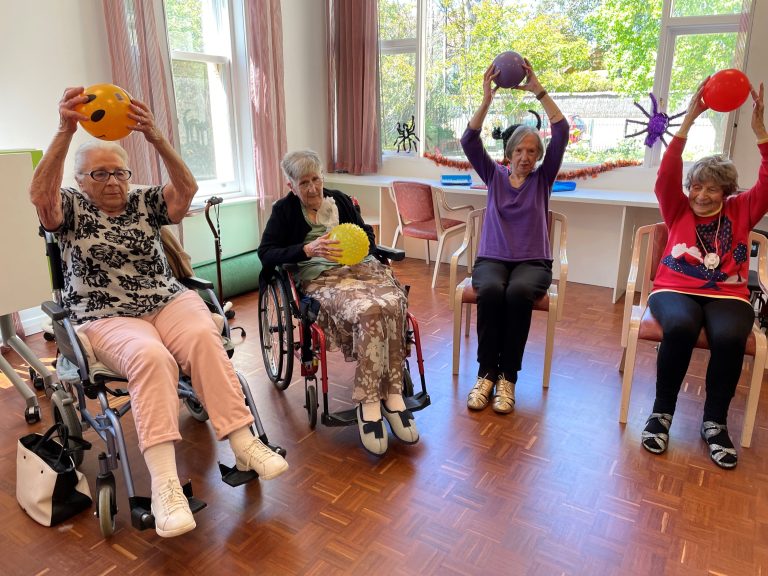
Chair yoga means yoga adapted for a dining chair or office chair, and it’s mostly aimed at older adults or anyone who finds a mat difficult. The person is expected to plant both feet, push off the floor, and often stand up holding the chair back.
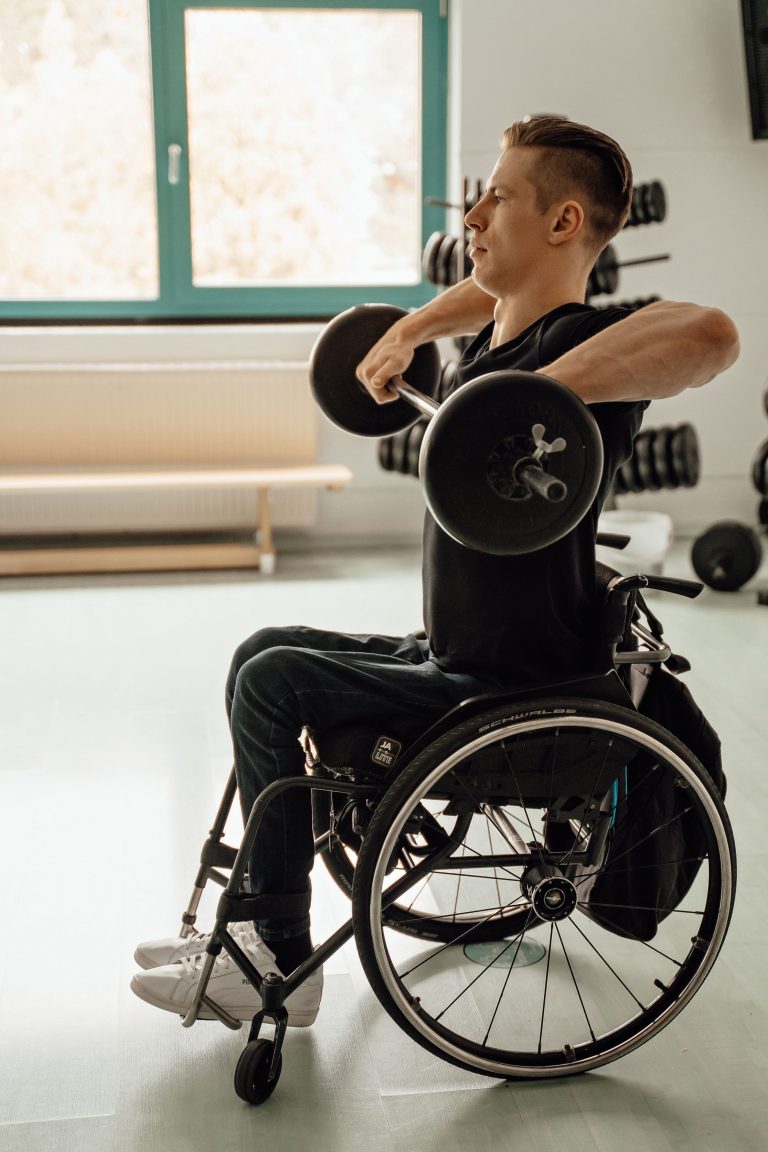
Wheelchair yoga starts from different assumptions. Your feet may be on footplates rather than the floor. Your chair has wheels and might roll. You may have limited or no trunk control, no sensation below a certain point, or a body that spasms when you change position. Half of chair yoga’s instructions simply don’t apply.
If you’re searching for classes, that distinction is worth using. A chair yoga class will be full of people whose bodies work differently from yours, taught by someone who’s probably never adapted anything for a powerchair.
What the Research Actually Shows
Yoga content tends to make big claims. The honest version is smaller and still worth your time.
The most relevant study is a pilot randomized controlled trial of a seated Iyengar yoga program for people with spinal cord injuries, run twice weekly for six weeks. Participants who did the yoga showed lower depression scores and higher self-compassion than the control group.
Twenty-three people. That’s a pilot, not a settled finding, and anyone citing it as proof is overselling. What it does suggest is that the mental health effects show up before the physical ones do, which matches what most people report anecdotally and is a reasonable thing to expect going in.
What you won’t find is good evidence that yoga detoxifies anything, massages your organs, or cures much of anything. Those claims turn up constantly in this space, and they’re not real. Flexibility, shoulder maintenance, breathing capacity,y and mood are the honest list.

The Part Yoga Videos Leave Out
Every one of these applies specifically because you’re in a chair, and none of them show up in a general yoga class.
Lock Your Brakes, Every Time
A forward fold or a twist shifts your weight off center. In an unlocked manual chair, that’s how you end up on the floor. Lock the brakes before you start and check them again if you’ve repositioned. If you use a powerchair, put it in neutral or power it off so a stray elbow doesn’t send you across the room.
Bone Density Changes What Stretching Costs
If you have a spinal cord injury, this one is not optional reading. Bone loss below the level of injury begins almost immediately and continues for life, and the MSKTC factsheet on bone loss after spinal cord injury reports that roughly half of people injured 10 years or more will fracture a bone at some point. Complete injuries carry higher risk than incomplete ones.
The detail that matters here is how those fractures happen. Most occur during ordinary transfers, from twisting or catching a leg. In more severe cases, the factsheet notes that simple movements like stretching or rolling over in bed can be enough.
That doesn’t mean don’t move. It means the aggressive end of any leg or hip stretch is not for you, and it means a physical therapist who knows your bone density should look at your routine before you do anything forceful with your lower body.
You Can’t Use Pain as a Limit If You Can’t Feel Pain
Every yoga article says to stretch until you feel mild tension and stop if it hurts. That instruction assumes working sensation.
Where sensation is absent or unreliable, you need a different limit. Use range instead of feel, meaning a set distance you don’t go past regardless of how it seems. Watch the joint rather than waiting for a signal. And check the skin afterward on anything that was loaded or in contact with a surface, because the same reason you can’t feel a stretch is the reason you won’t feel a developing pressure injury. The habits in this guide to preventing pressure sores apply directly to held poses.
Autonomic Dysreflexia at T6 and Above
If your injury is at T6 or higher, know the signs before you start. Sudden pounding headache, sweating or flushing above the injury, goosebumps, blurred vision, nasal congestion. Any strong stimulus below the level of injury can set it off, including a hard stretch, a full bladder you’d forgotten about, or a kinked catheter while you’re twisted sideways.
If it starts, stop, sit upright, loosen anything tight, and find the trigger. It’s a medical emergency, not a reason to push through.
Spasticity, Blood Pressure and Everything Else
Position changes trigger spasms in a lot of people, so move into poses slowly rather than dropping into them. If you get lightheaded coming up from a forward fold, that’s likely blood pressure, and it’s a reason to come up in stages rather than all at once. And if a shoulder is already sore from propelling all day, yoga isn’t the fix for that. Cardio and strength work and a conversation with a PT will do more.
Poses That Work From a Chair
Brakes locked. Start with whichever of these your body tolerates and leave the rest.
Seated Cat Cow
Hands on your knees or on your armrests. Breathe in, arch your back and look up, opening your chest. Breathe out, round your back and tuck your chin toward your chest. Move with the breath rather than pushing for range.
This is the one I’d start anyone with. It’s low risk, it works the spine in both directions, and it counteracts the forward slump that a day of pushing or driving a chair builds in.
Seated Twist
Sit as tall as you can. Breathe out and turn gently to the right, bringing your left hand to the outside of your right knee and your right hand behind you for support.
Go slower than feels necessary. This is the pose most likely to shift your weight, and if your trunk control is limited, do it with someone nearby the first few times or keep one hand firmly on the chair.
Eagle Arms
Reach both arms in front of you, cross the right over the left at the elbow, bend your elbows so your forearms come upright, and bring your palms toward each other. Hold for a few breaths and switch.
This one earns its place. It opens the upper back and shoulders, which is exactly where wheelchair use puts everything, and it carries almost no risk.
Seated Warrior
Sit tall and extend your arms out to the sides at shoulder height. Turn your head to look over your right hand, hold, then look over your left.
Simple, and better than it sounds for shoulder endurance and focus.
Forward Fold, With Conditions
Hinge forward from the hips on an exhale, letting your hands travel toward your shins or feet.
Three conditions on this one. Brakes locked, no exceptions. Come back up slowly, in stages, because this is the pose most likely to make you lightheaded. And skip it entirely if your trunk control won’t let you get back up unassisted, or do it with a strap around your chair back so you have something to pull on.
Breathing
Don’t skip this because it looks like the easy part. Slow breathing in through the nose and out through the mouth is where most of the mood benefit in that research probably came from, and it’s the one piece of this that carries no physical risk at all. It’s also useful on its own terms, alongside other no-cost ways to manage stress.
Props Are Not Cheating
Straps let you hold a position without gripping, which matters a lot if hand function is limited. A strap around a foot or looped around the chair back gives you leverage you don’t have to generate yourself.
Blocks extend your reach, so a pose that wants your hand near the floor becomes a pose where your hand rests on a block at whatever height works. Cushions help maintain alignment and take pressure off, though anything you’re sitting on for a long hold needs the same skin attention as the rest of your day.
Finding Instruction That’s Actually Adapted
Look for adaptive yoga or accessible yoga rather than chair yoga, since those are the terms teachers trained in disability adaptation tend to use. Ask directly whether they’ve worked with wheelchair users and what they’d change for someone with limited trunk control. A good answer is specific. A vague one about modifying as needed usually means they haven’t.
Rehabilitation hospitals sometimes run adaptive programs, and those tend to be the safest starting point because the instructor is working alongside people who know your medical history. Online classes are fine once you know what your body tolerates, and less good as a starting point, because nobody’s watching your chair move.
Setting Expectations
The mood effects tend to show up first, within weeks. Flexibility takes longer. Shoulder relief, if it comes, comes gradually and only if you’re consistent.
The failure mode I’d watch for isn’t injury; it’s quitting. People start with the ambitious version, find it frustrating or exhausting, and stop. Ten minutes of cat-cow and breathing, done regularly, beats a full session you do twice and abandon.
And if the reason you’re here is the mental health side rather than the physical, that’s a completely legitimate reason to start, and it’s also worth knowing that mental health and disability are a bigger conversation than any exercise routine can carry on its own.
This article is general information, not medical advice. Talk to your physician or physical therapist before starting any new exercise routine, particularly if you have a spinal cord injury, osteoporosis, or a history of autonomic dysreflexia.