Almost everything written about dressing aids is aimed at someone six weeks out from a hip replacement. That’s where these tools come from, and it’s why every guide you find assumes you’ll be back to bending over by spring.
Some of us won’t be. The tools still work, but the advice around them doesn’t, because it’s written as temporary. When this is how you dress permanently, different things matter. Durability matters. Whether you can use it one-handed matters; whether it works from a chair rather than from the edge of a hospital bed matters a great deal.
Work Out What’s Actually Stopping You
This is the step people skip, and it’s why so many of these end up in a drawer.
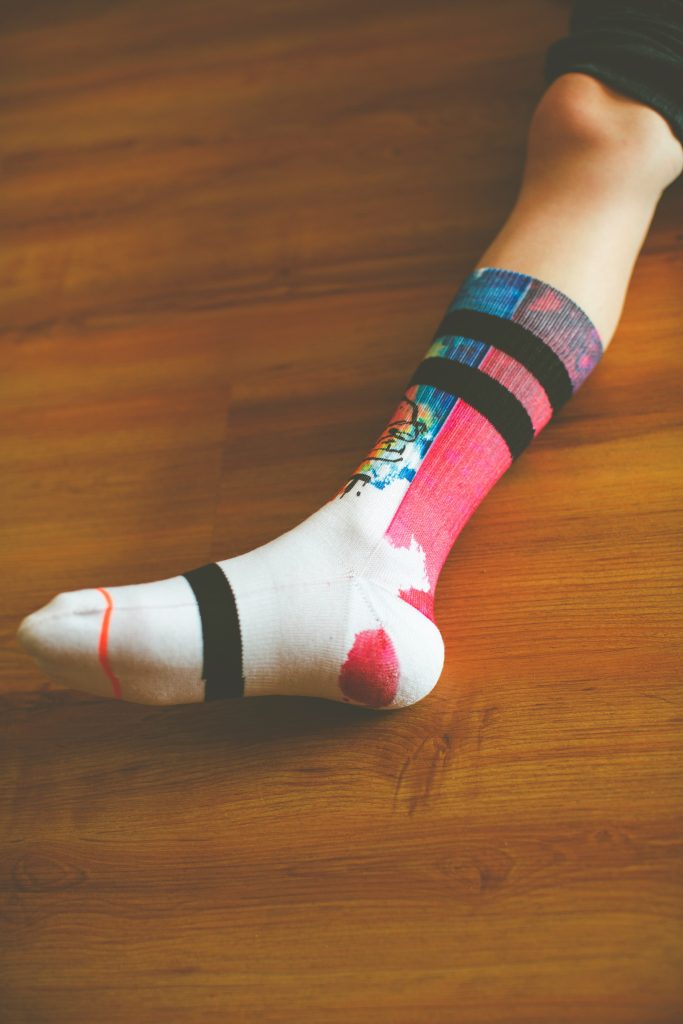
“I can’t get my socks on” isn’t one problem. It’s at least four, and they need different tools.
- Reach. You can grip fine; you just can’t get your hands to your feet.
- Grip and dexterity. You can reach, but fasteners and small fabric defeat you.
- Balance and trunk control. Leaning forward is possible but unsafe, or you can’t get back up from it.
- One-sided weakness. One hand works, the other doesn’t, so anything needing two hands is out.
- Pain and fatigue. You can do it, and it costs more than it’s worth, so it eats the morning.
Buy the wrong one, and the tool is useless. A sock aid solves reach and does nothing for grip. A button hook solves grip and doesn’t help you get to your feet.
Socks and Compression Stockings
A sock aid is a plastic or fabric cradle. You stretch the sock over it, drop it to the floor with the attached cords, put your foot in, and pull. Your foot never meets your hand.
Two things decide whether it works for you. Rigid plastic ones hold their shape and are easier to load, but they’re bulkier and less forgiving on a swollen foot. Flexible fabric ones fold around the foot better and are harder to get the sock onto in the first place.
Compression stockings are their own category and need a version built for them, because standard sock aids won’t stretch compression fabric far enough. If you wear compression, buy that specifically rather than assuming.
Expect a learning curve. Most people are clumsy with one for a week and then never think about it again.
Shoes
An angled-head shoehorn is the simplest thing on this page and probably the most used. Eighteen to twenty-four inches, angled head, and it slides the heel in without you bending at all.
The bigger win is often the laces rather than the shoe horn. Elastic no-tie laces turn any lace-up shoe into a slip-on permanently, and they cost almost nothing. If you can’t tie laces, that’s usually a better answer than buying different shoes.
Adaptive shoes, proper, meaning wide openings and full zip or Velcro entries, are worth it if your feet swell or if orthotics are involved. Just be aware that searching for them pulls up a lot of local retailers and medical suppliers rather than useful comparisons.
Pants and Lower Body
A dressing stick is a long rod with a hook at one end and usually a push pad at the other. You hook the waistband, lift the garment over your feet, and pull it up your legs without leaning forward.
A leg lifter is the companion piece, and it does more than dressing. It’s a strap or rigid rod with a loop for your foot, and it lets you move a leg that won’t move on its own. Getting into bed, repositioning on a footplate, crossing one leg over the other. Plenty of people use one daily and never think of it as a dressing aid at all.
One technique worth knowing: dressing lying down is easier than dressing seated for a lot of people, because you can roll rather than lift. If you’re fighting to get pants past your hips in a chair, try it flat.
Buttons, Zips and Fasteners
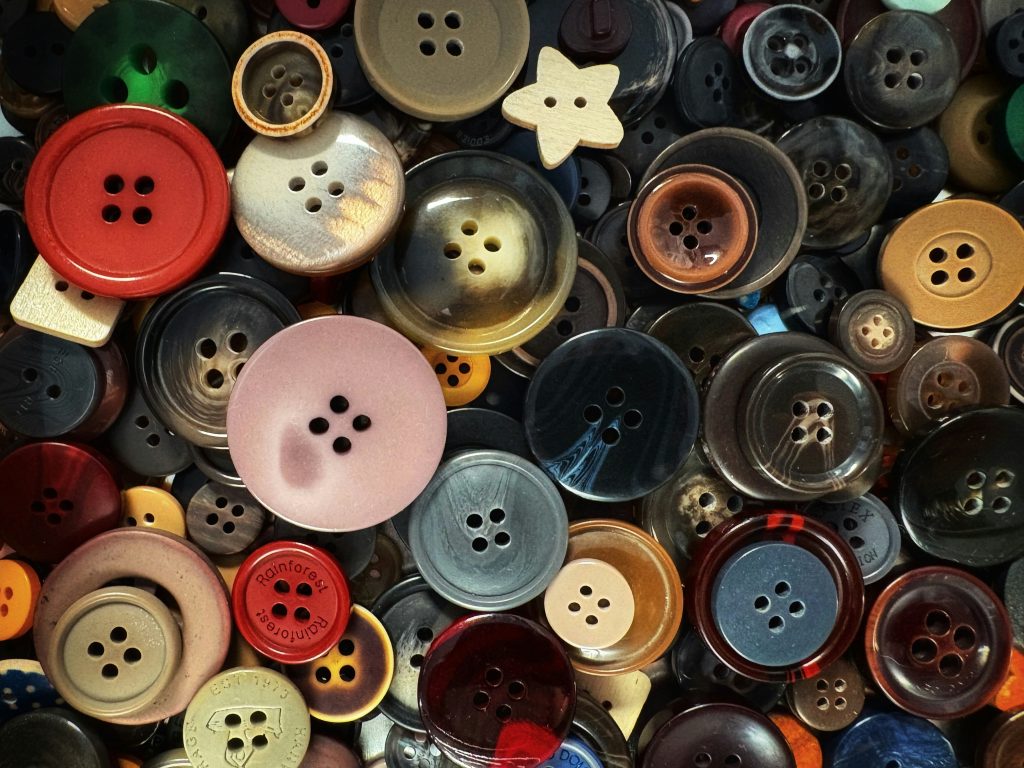
Personally, I avoid most clothing that has to stay on my body because of buttons or zippers. It’s more than just a hassle, it’s uncomfrotable. But if you’ve got your eye on an outfit that requires it, check out a button hook. A button hook is a wire loop on a handle. Push the loop through the buttonhole, catch the button, and pull it back through. Most come with a zipper pull hooked on the other end.
Before you buy one, though, consider changing the fasteners instead. Magnetic closures replace buttons entirely and look identical from the outside. Sewing a small loop onto a zipper pull costs nothing. Swapping to elastic waists, pullover tops, and front-fastening bras removes the problem instead of solving it.
The tool is for the shirt you love. The swap is for everything else.
Reaching Everything Else
A reacher earns its place faster than anything else here, because it stops being a dressing aid within a day. Dropped keys, high shelves, the sock behind the dryer, the remote on the far cushion.
What to look for. Length matched to your actual reach rather than the longest available, since a thirty-two-inch reacher is unwieldy indoors. A jaw that closes fully, because cheap ones flex and drop things. A magnet on the tip, which is more useful than it sounds. And a folding version if you want one in a bag.
Get two. One where you sit and one where you sleep. They’re cheap enough that keeping one in each room removes more small frustrations than any other single purchase.
What to Check Before You Buy Any of It
- Can you use it with one hand? If not, and you only have one reliable hand, it doesn’t matter how good it is.
- Does the length match your reach, not an average? Too long is as bad as too short.
- How’s the grip? Thin plastic handles are hard work with arthritis or weak hands. Foam or contoured grips cost slightly more and change the experience.
- How heavy is it? Anything you hold at arm’s length feels heavier than it is.
- Will it live where you need it? A tool in the other room is a tool you won’t use.
Why These End Up in a Drawer
Most people who own dressing aids own at least one they’ve abandoned. It’s worth knowing why, because the reasons repeat.
It was bought for the wrong limitation. It came as part of a kit rather than being chosen. Nobody demonstrated it, so it got tried once, badly, and written off. Or it was issued for a temporary situation and never revisited when things changed.
That last one is a real pattern. Hospital hip kits are handed out as a bundle, typically a reacher, long-handled shoehorn, long-handled sponge, dressing stick, and sock aid, and the standard patient handouts that come with them assume you’ll stop needing them.
Worth knowing too that the whole approach has been questioned. A survey of occupational therapists and physiotherapists found that precautions and equipment have been a significant source of frustration for patients, partly because they slow the return to ordinary activity. That’s aimed at post-surgical recovery rather than at us, but the underlying point carries. Equipment that removes an activity isn’t automatically a win. Equipment that lets you do the activity is.
Get Someone to Show You Once
The single highest value thing on this page isn’t a product.
An occupational therapist will watch you dress, identify which limitation is actually the problem, and demonstrate the right tool. That’s usually one appointment; it’s frequently covered, and it prevents the entire drawer full of abandoned equipment.
Ask specifically for an evaluation for adaptive dressing equipment. If you’re already seeing a therapist for something else, ask them. It’s a fifteen-minute conversation that saves months of trial and error.
Beyond Getting Dressed
The same principle runs through the rest of the house, and the same category of daily living aids covers it.
Weighted utensils steady a tremor. Built-up handles help when grip is the issue. A jar opener mounted under a cabinet does the twisting for you. One-handed cutting boards hold food in place with spikes and a corner guard. Adaptive can openers, kettle tippers, and non-slip mats all remove a two-handed task.
Most of it is cheap, none of it requires a prescription, and it’s the same question every time. What exactly is stopping you, and what’s the smallest thing that removes it?
For the gear that lives on the chair rather than in the kitchen, the rundown of wheelchair accessories that actually get used covers that side, and if the real obstacle is the room rather than the task, that’s a home modification question instead.
Final Thoughts
Name the limitation before you buy the tool. Reach, grip, balance, one-sidedness, and fatigue all look identical from the outside and need completely different answers. Then start with a reacher and long-handled shoehorn, because they’re cheap, they’re useful within an hour, and they’ll tell you quickly whether the problem you thought you had is the one you actually have.
Frequently Asked Questions
What Are Dressing Aids?
Tools that let you dress without bending, reaching, or gripping in ways your body can’t manage. The common ones are sock aids, dressing sticks, long-handled shoe horns, button hooks, and reachers.
How Do You Use a Sock Aid?
Stretch the sock over the cradle, lower it to the floor by the cords, slide your foot into the opening, and pull the cords until the sock is on and the cradle slips free. It takes a few attempts to get the sock loaded evenly.
Does Insurance Cover Dressing Aids?
Usually not. Most of these are inexpensive enough to be out of pocket, and Medicare generally doesn’t cover them as durable medical equipment. Medicaid waivers sometimes cover assistive technology, so it’s worth asking.
What’s the Difference Between a Reacher and a Dressing Stick?
A reacher has a trigger-operated jaw for gripping and lifting objects. A dressing stick is a simple hook for catching and pulling clothing. A reacher can do some dressing tasks. A dressing stick can’t pick anything up.
What Length Reacher Should I Get?
Most people are best served between 26 and 32 inches. Shorter is easier to control and better indoors. Longer helps if you need a floor-to-high-shelf range, at the cost of precision.