Colorectal cancer is one of the most preventable cancers there is. Caught early, it’s highly treatable, and screening doesn’t just find it; it removes the growths that would have become cancer. That’s an unusually good deal in cancer medicine, and most people get to take it without thinking twice.
Screening rates among people with mobility disabilities are consistently lower than among everybody else. Not because the risk is lower, and not because people care less about their health. Because the prep protocol asks for things a lot of bodies can’t do, and once a test is deferred for a practical reason,n it tends to stay deferred.
That’s a solvable problem, and part of the solution already exists. Screening options exist that require no prep at all, and most people are never told about them.
What the Prep Actually Demands
The goal is an empty colon, because anything left behind hides what the camera is looking for. An inadequate prep means the whole thing gets repeated, which is why clinicians insist on following the instructions exactly. It isn’t fussiness;s, it’s the difference between a useful result and a wasted day.
It runs across three stages. For several days beforehand, you move to a low-residue diet, cutting out fiber, seeds, nuts, and raw vegetables. The day before, you switch to clear liquids only, then drink the prep solution itself, usually split into two doses, one in the evening and one early on the morning of the procedure.
After each dose, you’ll have several hours of urgent, repeated, unpredictable diarrhea. It starts roughly an hour in and continues until you’re passing clear fluid. Split dosing matters, and you shouldn’t skip the morning half, because that second dose clears the right side of the colon.
The Assumptions Nobody Names
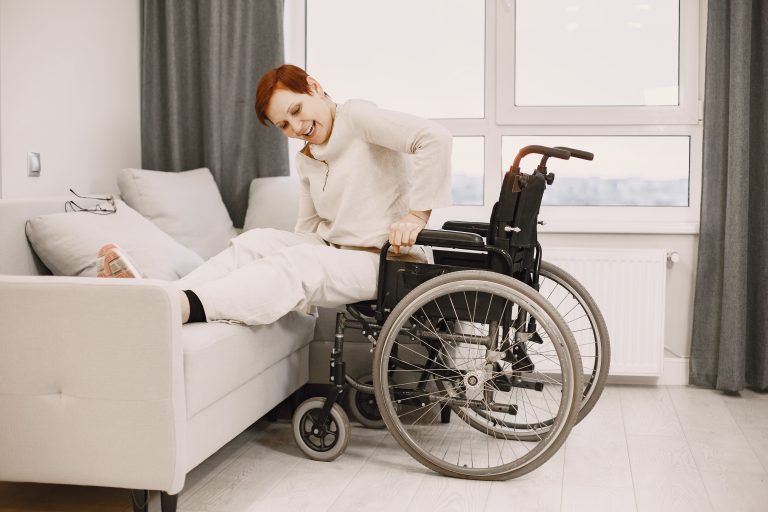
Put plainly, that protocol requires a specific set of capabilities. It assumes you can get to a toilet quickly, from wherever you happen to be, many times across several hours. It assumes you can transfer on and off independently and at speed, repeatedly, including in the middle of the night when you’re exhausted and dehydrated.
It also assumes your bathroom is set up for that and close enough to reach in time. For most people, all of this is unremarkable, which is exactly why it never appears in the instructions. For a wheelchair user, somebody whose transfers take planning, or anyone who needs another person to help, every one of those assumptions is a question rather than a given.
And if you run a bowel program, the prep flattens it. Several days of low residue eating followed by a full purge disrupts a routine that took months to establish, and there’s essentially no published guidance on getting it back afterward. That subject is covered in the piece on neurogenic bowel and how a bowel program works.
How a Deferral Becomes a Decade
This is the part that actually costs people, and it doesn’t happen by choice. Nobody sits down and chooses to skip cancer screening. What happens is that the logistics look impossible this year, so it gets put off, then put off again because nothing has changed.
Colonoscopy is recommended every ten years for average-risk adults, which means a single deferral isn’t a short delay. Miss the window, and the next natural prompt may be years away, and in the meantime nothing is being looked at. A growth that would have been removed in a ten-minute procedure continues quietly.
The other thing that keeps it deferred is how the conversation goes. Somebody says the prep would be difficult, the clinician hears reluctance, and the response is reassurance rather than problem-solving. Both people leave the room thinking the matter is settled and neither has actually addressed it.
The Options That Involve No Prep at All
Here’s what rarely comes up. Colonoscopy is one of several screening approaches recommended by the US Preventive Services Task Force, and for average-risk adults the stool-based tests are legitimate options rather than consolation prizes. They tend to be presented as what you settle for if you won’t do the real thing, which badly misrepresents them.
No diet, no purge, no transfers, no sedation, no companion, no day off work. For somebody for whom the prep is the entire obstacle, that isn’t a slightly easier version of the same thing. It’s a different order of difficulty, and it’s the difference between screening happening and not happening.
FIT, the Fecal Immunochemical Test
An annual test that detects blood in the stool using antibodies. Sensitivity for colorectal cancer runs around 74 percent, and considerably lower for advanced precancerous lesions at roughly 24 percent. It’s the most widely used stool test worldwide, and it’s inexpensive.
The detail that matters most here is the collection method, and nobody mentions it. FIT needs a small smear taken from the surface of a stool, using a stick or brush supplied in the kit. If reaching, positioning, or dexterity is difficult for you, that is about as manageable as this gets.
Multi-target Stool DNA Testing
Usually done every three years, this looks for DNA markers shed by cancer cells alongside detecting blood. Sensitivity is substantially better, around 92 percent for cancer and 42 percent for advanced precancerous lesions. Specificity is lower, though, which means more false positives and more follow-up colonoscopies that find nothing.
The catch is the collection, and it’s significant. This test requires an entire bowel movement captured in a container that sits on the toilet, then packaged and posted. If you use a commode, a shower chair positioned over a toilet, or need assistance with toileting, that is meaningfully harder than a smear, and it’s worth knowing before you choose between them.
What CT Colonography Doesn’t Solve
Sometimes called a virtual colonoscopy, and frequently suggested as the gentler option. It isn’t, at least not for this purpose, because it still requires the full bowel prep beforehand. What it avoids is sedation and the scope the day before, so it solves a problem you probably don’t have.
Newer blood-based screening tests have also appeared and are starting to be offered. The evidence base is still developing, and guidelines have been cautious so far. Worth asking about, worth watching, and worth not relying on until the picture is clearer.
The Honest Comparison
These options aren’t equivalent, and pretending otherwise would be useless. A colonoscopy looks directly at the entire colon and removes polyps during the same procedure, which means it both detects and prevents. Stool tests only screen; they’re notably weaker at catching precancerous growths before they turn into cancer, and they need repeating far more often.
There’s also a consequence people don’t anticipate. A positive result means you’re having a colonoscopy regardless; it’s just diagnostic rather than screening, which can change what you’re charged. Worth asking about in advance rather than discovering it on a bill.
The argument in favor is straightforward anyway. The best screening test is the one that actually gets done, and an annual FIT completed every year for a decade catches considerably more than a colonoscopy that keeps being deferred. That’s a clinical judgment rather than rationalization,n and modeling comparing frequent stool testing against less frequent approaches supports it.
Which reframes the decision entirely for some people. If the prep genuinely isn’t achievable, the real comparison isn’t stool test versus colonoscopy. It’s stool test versus nothing, and nothing is by a wide margin the worst option on the table.
If You’re Doing the Prep Anyway
Plenty of people will, either by choice or because a stool test came back positive and this is now diagnostic. The following makes it considerably more manageable, and none of it appears in the standard instruction sheet.
Tell the scheduling team about your mobility and ask what the facility can actually accommodate, including whether they have a height-adjustable table and how you’ll get onto it. That conversation is far better had three weeks out than on the morning.
Ask about the prep formulation, because there are several and they differ in volume. Some are four liters and some considerably less, and the choice is often negotiable if you say that volume is a problem.
Set the bathroom up completely in advance. Wipes, barrier cream, a change of clothes, something to drink, a phone, all within reach before you start. Skin takes a genuine beating over several hours, and barrier cream applied early beats treating soreness afterward.
Arrange help for the prep, not just the procedure. You need a companion afterward because of the sedation, and you may well need one during. Asking is easier than managing alone at two in the morning.
Flag anything autonomic. If your injury is at T6 or above, bowel distension and rapid emptying are both recognized triggers for autonomic dysreflexia, and the team needs to know before rather than during.
What to Ask For
Go in with the obstacle named rather than with a vague reluctance, because the two get completely different responses. Say plainly that the prep is difficult for specific reasons and list them. Repeated urgent transfers, bathroom access, needing assistance, disruption to a bowel program.
Then ask directly what the alternatives are for average-risk screening, and whether FIT or stool DNA testing is appropriate given your history. If you’re higher risk because of family history or a previous finding, the honest answer may be that colonoscopy is the only adequate option. That’s worth establishing rather than assuming in either direction.
Ask about cost while you’re there. Medicare and most private insurers cover stool-based screening with no copay, which surprises people who assume the easier option costs more. A follow-up colonoscopy after a positive result may be billed differently, and knowing that in advance is better than finding out afterward.
A Gap That Doesn’t Need to Exist
The reason this matters is that colorectal cancer screening genuinely works, and the people currently missing out on it aren’t missing out because of anything about their cancer risk. They’re missing out because a preparation protocol was designed around a body that transfers easily, and nobody thought to check whether that described everyone.
The at-home tests won’t suit every situation, and they aren’t as good as a colonoscopy on the measures that matter most. But they’re enormously better than a decade of nothin’; they can be completed by people for whom the standard route is genuinely out of reach, and they close a gap that shouldn’t have been there in the first place.
If you’ve been putting this off for practical reasons, that’s worth one conversation. Name the obstacle rather than the hesitation, ask what else is available, and find out whether the thing standing between you and screening is actually necessary.
This is general information rather than medical advice. Screening recommendations depend on your age, family history, and risk factors, so the right option is a conversation with your own clinician.