Ableism is discrimination or prejudice against disabled people, and the assumption underneath it is that a non-disabled body is the default and everything else is a deviation from it.
That’s the definition. It’s accurate, and it’s also where most articles stop, which leaves people with the impression that ableism is something rude individuals do.
Some of it is. Most of it isn’t, and the most useful thing I can tell you is where the rest of it actually lives.
The Three Forms It Takes
Individual. The comments, the staring, the person who talks to whoever is pushing your chair instead of to you. The version everybody recognizes.
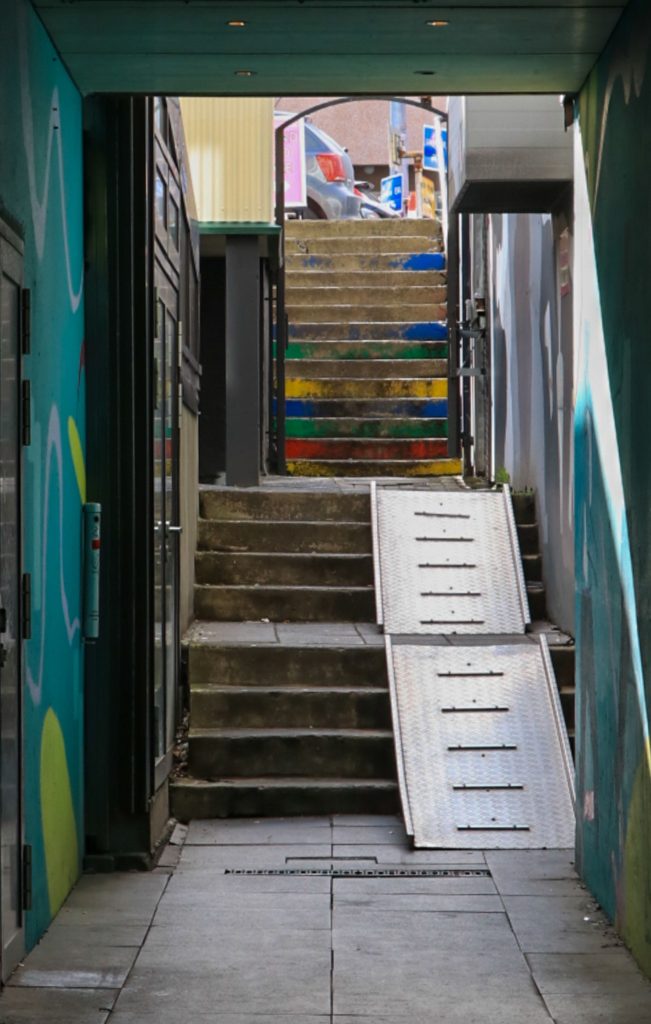
Structural. The step at the entrance. The form that assumes you can hold a pen. The insurance code that classifies bathing equipment as convenience. Nobody decided to exclude anyone. Somebody just designed something without a disabled person in mind.
Internalised. The version that happens inside your own head, where you absorb the assumption and apply it to yourself. That one has its own section further down, because it’s the one people recognize least and carry longest.
Most writing on this subject focuses on the first kind, because it has villains and villains are easier to write about. The second kind does most of the actual damage.
Almost Nobody Is Being Cruel
I want to be clear about this, because it shapes everything that follows.
The vast majority of what limits my day was not put there by anyone who wished me ill. It was put there by people who never had reason to think about it, which is a completely different thing.
You cannot see a barrier you’ve never hit. If your body has always got you through doors, you have no reason to notice how wide they are. If you’ve always been able to stand up in a shower, the idea that a shower chair might be classified as a convenience item rather than a medical one wouldn’t occur to you, because bathing seated has never been a thing you had to solve.
That’s not a moral failing. That’s how attention works. I don’t expect anybody to have audited a building they walk through without thinking.
So when I roll up to your house, and there’s a step, I’m not angry at you. Genuinely. You built a house, or bought one, in a world where every house has a step, designed by people who also weren’t thinking about it.
Here’s Where the Frustration Actually Sits
It isn’t the not noticing. It’s how long it takes for anything to change once somebody does.
The Americans with Disabilities Act passed in 1990.Thirty-five years. And the mechanics of that law explain a great deal about why so much is still inaccessible, which is worth understanding rather than just resenting.
Existing buildings were never required to be brought up to standard wholesale. The obligation is to remove barriers where doing so is readily achievable, which is a genuinely low bar, and one that a small business in an old building can often meet by doing very little. New construction is held to the full standards. Everything already standing largely isn’t.
And enforcement is complaint-driven. Nobody inspects. Nothing happens until a disabled person notices, complains, and follows it through, which is covered in more detail in the piece on what the ADA actually is and what it doesn’t cover.
So the system is built so that change requires a disabled person to spend their own time and energy demanding it, one building at a time, forever.
What That Costs, Specifically
This is the part I’d most like non-disabled readers to sit with.
Every single accommodation I’ve ever received, I asked for. Every one. The ramp, the reroute, the different table, the earlier appointment, the meeting moved downstairs. None of it happened because somebody looked at a situation and thought ahead.
Asking is not free. It takes time, it takes nerve, and it takes energy out of a supply that’s already finite. The whole subject of what that arithmetic looks like is in the piece on explaining your energy to somebody who doesn’t get it, and a substantial share of mine goes on requesting things that could simply have been the default.
Sometimes I don’t ask, because I’ve done it four times that week and I’m tired. That’s not acceptance. That’s a budget running out.
Three Examples From My Own Life
Not to make a point about anyone in particular. To show what structural ableism looks like when nobody involved has done anything wrong.
I shower in an old manual wheelchair. Because Medicare classifies bath and shower seats as comfort, convenience, and hygienic equipment rather than as medical equipment, and the version I could move myself was never going to be covered. Somebody wrote that classification. They were not thinking about me, and the consequence is that I use a twenty-year-old chair in a wet room. The full version of that story is here.
And every December there’s a house I can’t celebrate at, not because of the front step, which people do think about, but because of the coffee table and the tree and the extra dining chairs. That one is in the piece about the holidays. Nobody has ever once thought about the coffee table.
Three situations. Zero villains. All three shaped my life more than any rude comment ever has.
Internalised Ableism
The version that lives in your own head, and the one that took me the longest to recognize.
It’s apologizing for taking up space. It’s declining help you need because accepting it feels like proof of something. It’s putting off using a mobility aid for years because using one before you absolutely must feels dishonest, which is a belief that costs people conditioning, income, and whole parts of their lives for no medical reason at all.
It’s also measuring yourself against what you used to be able to do, or against what a non-disabled person manages, and finding yourself lacking on a scale that was never built for you.
You absorb the default that everybody else does. Nobody hands you a different one when your body changes.
The way out of it isn’t positivity. It’s noticing when the voice in your head is repeating something you were taught rather than something that’s true.
What Actually Changes Things
Not attitudes, mostly. Decisions.
Ask the question earlier.
If you’re planning anything, the useful moment is while it’s still on paper. Retrofitting is expensive, and getting it right at the start is usually free.
Publish what you know.
Whether there’s a step, where the bathroom is, how wide the door is, most decisions about whether to attend something get made days in advance by somebody who can’t find out, and a family who can’t find out assumes the answer is no.
Fix it once rather than accommodating repeatedly.
Carrying somebody up a step is kind. A ramp means nobody has to be carried, and nobody has to ask.
When somebody tells you something doesn’t work, believe them the first time.
They’re not raising it lightly. Raising it cost them something. Pride, mostly. But also? The fear of feeling like a burden or second-class person, just because they can’t function independently in a location. Nobody’s lying about that.
And notice when a rule is doing the excluding.
The coverage code, the policy, the form. That’s where most of it lives, and it’s the part that can actually be rewritten.
What I’m Actually Asking For
I don’t need you to have noticed. I’ve made my peace with the fact that people can’t see barriers they’ve never hit, and I’d probably have missed most of them myself before this was my life.
What I’d like is for it not to take another thirty-five years once somebody does notice. For the fix to happen the first time it’s raised rather than the fourth. For the default to change, so that the next person doesn’t have to spend their Tuesday explaining what a doorway is for.
That’s the whole argument. Not anger at anybody. Impatience with how slowly a thing gets fixed once everybody agrees it’s broken.