
I shower in an old manual wheelchair.
Not because it’s ideal, and not because nothing better exists. Because when I asked about a shower chair I could move myself, I was told it wouldn’t be covered, and that was the end of the conversation. So I used equipment I already owned.
I’ve since learned that answer was true and incomplete at the same time, which is worse than it being wrong. This is what I wish somebody had explained.
There Are Five Products Hiding Behind One Search Term
Type shower chair into a search bar and you’ll get a wall of forty-dollar plastic stools. That’s one product out of at least five, and they’re for completely different situations.
A basic shower chair or stool. Plastic, four legs, sometimes a low back. You walk into the shower and sit down on it. This is the default result, and it’s built for someone with balance problems who can still stand and step. If you can’t do both of those things, it’s the wrong product no matter how good the reviews are.
A shower bench. Longer, sits inside the shower, gives you somewhere to slide along rather than a single seat. Better for anyone with limited hip movement, still assumes you can get onto it.
A transfer bench. This one straddles the tub wall, with two legs inside and two out. You sit down on the dry outside end and slide across rather than stepping over. For anyone dealing with a bathtub who can’t lift a leg over the side, this is the actual answer, and it’s a different product from a shower chair entirely.
A rolling shower commode chair. Looks like a wheelchair with an open seat. It rolls into a roll-in shower and often over a toilet, which means one transfer covers both. This is what most full-time wheelchair users actually need, and it’s where the whole thing gets complicated.
A tilt-in-space shower chair. The rolling version with positioning support, for anyone who needs trunk support or pressure redistribution while seated. The most expensive category and the least visible online.
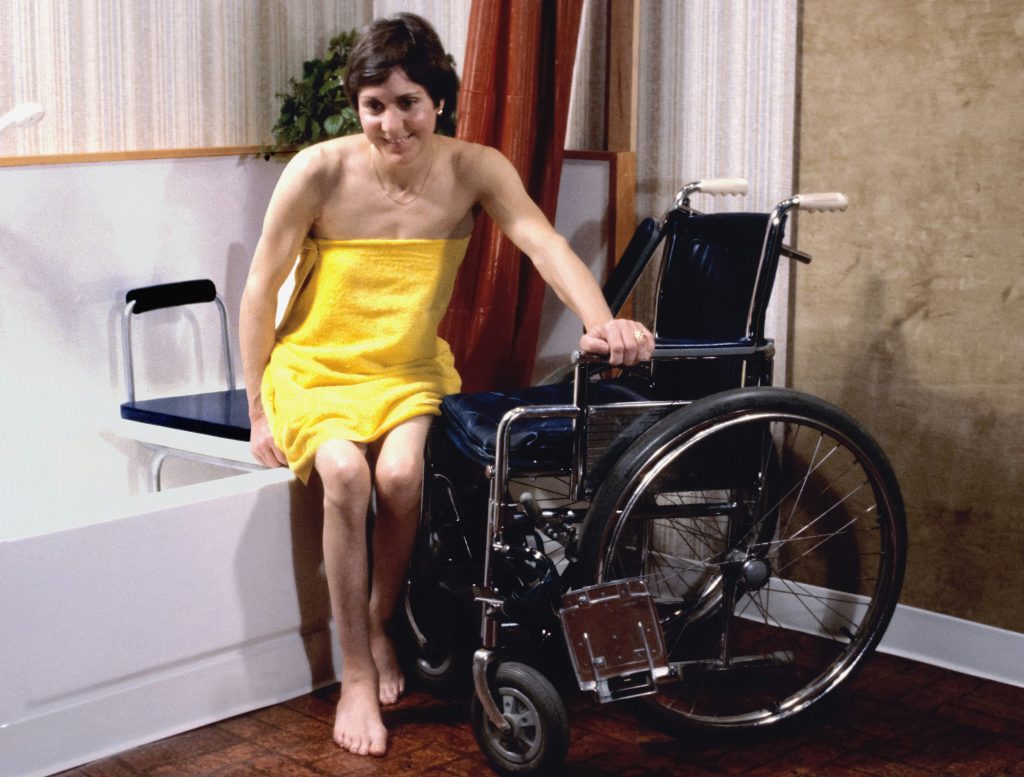
Two Assumptions That Leave People Out
Look at that list, and you can see two different bodies being designed for.
The consumer end assumes you can stand. Everything cheap and everything reviewed assumes you’ll walk into the shower and lower yourself onto a seat. That’s the largest market: older adults and people recovering from surgery, so it’s what gets made and what gets written about.
The medical end assumes somebody is pushing you. Rolling shower commodes overwhelmingly come with small rear wheels and push handles, because the buyer being designed for is a facility or a family member. Models you can propel yourself exist, and they cost considerably more, and they’re much harder to get approved.
Which leaves out a specific person. An adult who can’t walk but can move themselves, and would like to keep doing that in the one room where privacy matters most. That person is invisible to both halves of the market.
So they improvise. I’m not the only one using an old chair in a shower.
What Insurance Actually Covers, and Why
Here’s the rule underneath all of it, and once you know it, the whole category makes sense.
Medicare covers durable medical equipment, which has to be durable, appropriate for home use, expected to last at least three years, and primarily medical in nature. That last phrase is doing all the work.
Shower chairs fail it. CMS classifies bath and shower seats as comfort, convenience, and hygienic equipment, which puts them outside DME entirely. The same reasoning excludes grab bars, raised toilet seats, transfer benches,s and walk-in tubs. The logic is that bathing equipment makes something easier rather than treating something medical.
Commode chairs, though, are covered. Part B pays for them as DME when a doctor orders one for home use because you can’t use a regular toilet. Same bathroom, same person, different classification, because a commode is treated as toileting equipment rather than bathing equipment.
You can probably see where this goes.
The Route Almost Nobody Mentions
A rolling shower commode chair does both jobs. It rolls over a toilet, and it rolls into a shower.
Which means it can sometimes be approved under the commode chair code rather than being denied as bathing equipment. The prescription and documentation have to be built around toileting need, not around showering, and the equipment has to be coded correctly by a Medicare-enrolled supplier.
That’s the thing I didn’t know. When I was told a shower chair wouldn’t be covered, that was accurate. What wasn’t said, and probably wasn’t known, is that a different item under a different code might have been.
Doctors aren’t billing specialists. They know what usually gets denied, and they tell you that in good faith, and most people take it as final. The person who actually knows this stuff is a DME supplier or an occupational therapist who does equipment assessments, and neither of them is who you’re sitting in front of when the subject comes up.
If you take one thing from this article, take that. A no from a doctor about coverage is not a coverage decision. It’s an opinion about a coverage decision, and it’s frequently wrong in either direction.
How to Actually Go About Getting One
Start with an occupational therapist rather than a catalog. An OT who does equipment assessments will look at your bathroom, your transfers, and your body, and tell you which of those five products fits. They also write the documentation that makes a claim work. This is the step people skip,p and it’s the one that changes outcomes.
Get the prescription written for what you need, not for what you think will be approved. If a rolling shower commode is the right equipment, the paperwork should say so and say why, in terms of what you can’t do without it. Pre-emptively downgrading your own request is how people end up with equipment that doesn’t work.
Use a Medicare-enrolled DME supplier. Buying the right chair from the wrong place means it isn’t covered regardless of the paperwork.
Ask specifically about the commode code. Not “will you cover a shower chair,” which gets a fast no. Ask whether a rolling shower commode chair can be billed as a commode chair for someone who can’t transfer to a standard toilet.
Get the denial in writing if it comes. A verbal no from a receptionist isn’t appealable. A written denial is, and it names the reason, which tells you what to argue.
If It Genuinely Isn’t Covered
Sometimes the answer really is no. These are the routes worth trying, roughly in order of how much they’re worth.
Medicaid, if you have it. Coverage is state by state and considerably more generous than Medicare in some places. Home and Community Based Services waivers cover bathroom equipment in many states under environmental accessibility adaptations, which is the phrase to use on the phone.
Medicare Advantage over-the-counter benefits. A lot of plans include an allowance that covers bathroom safety items Original Medicare won’t touch. Worth checking your own plan, and worth remembering at open enrollment.
VA housing grants, if you’re a veteran. The HISA grant covers bathroom modifications, and it’s substantially more generous than anything else on this list.
Equipment reuse programs. Loan closets, independent living centers, and durable medical equipment recycling programs all handle shower chairs, and rolling commodes turn up regularly because they get returned when someone dies or moves into care. The same organizations that accept donated medical equipment are often the ones handing it back out.
Buying used. A rolling shower commode is expensive new and considerably less so secondhand, and it’s a product where used is genuinely fine as long as the frame is sound.
What People Actually Do
Which brings me back to the manual chair.
Using an ordinary wheelchair as a shower chair is common, unofficial, and completely absent from anything written about this equipment. So here’s what I’ve learned, in case you end up doing the same.
Rust is the whole battle. Bearings, spokes, screws, the frame where the coating has chipped. Rinse it with clean water afterward and dry what you can reach. A chair that lives in a wet room will not last as long as one that doesn’t.
Upholstery holds water and grows things. Standard sling seats and backs stay damp for hours. Mesh or a replaceable cover is better, and whatever you use needs to actually dry between showers.
Brakes behave differently on wet tile. Test that before you rely on it, not while you’re transferring.
Cushions come off. Your pressure cushion is not shower equipment, and soaking it will destroy it.
It doesn’t help you drain. A closed seat holds water underneath you, which is the single biggest functional difference from a purpose-built chair, and it matters for skin.
None of that makes it a good solution. It’s a workaround, and I’d rather have the right equipment. But people are doing it, and doing it badly costs you a chair and possibly your skin, so it’s worth saying out loud.
Where This Sits in the Bigger Picture
A shower is one step inside a much longer process. Mine runs to four transfers and over an hour, and the chair is one part of that. Getting the chair right and the threshold wrong, or the door width wrong, or having nowhere dry to dress afterward, gets you a chair you can’t use.
If you’re solving this from scratch, the room matters as much as the equipment, and that’s covered in the guide to setting up an accessible bathroom without a full renovation.
Bathing Better
Work out which of the five products your body actually needs before you look at a single price. Get an occupational therapist to confirm it. Then ask about the commode code rather than about shower chairs, because the classification decides the answer more than your need does.
And if somebody tells you it isn’t covered, ask them whether that’s a decision or an assumption. Mine was an assumption, and I spent years in an old wheelchair because I didn’t know to ask.
Coverage rules change and vary by plan and state. Verify current Medicare rules at medicare.gov and check your own plan documents before making decisions.