This is general information, not medical advice. Talk to a clinician or physical therapist before starting a new exercise program, particularly with a cardiac condition, recent fall, recent injury, or recent surgery.
Most chair exercise content treats seated movement as a consolation prize. Gentle, cheerful, ten minutes of arm circles, no progression, no expectation that anybody gets fitter.
The official guidance doesn’t work that way. The Physical Activity Guidelines ask for 150 to 300 minutes of moderate aerobic activity a week, plus muscle strengthening on two or more days working all the major muscle groups. Adults over 65 are asked for the same, with balance work added. And adults with chronic conditions or disabilities, where able, are told to follow the same guidelines as everybody else.
Not a reduced version. The same one.
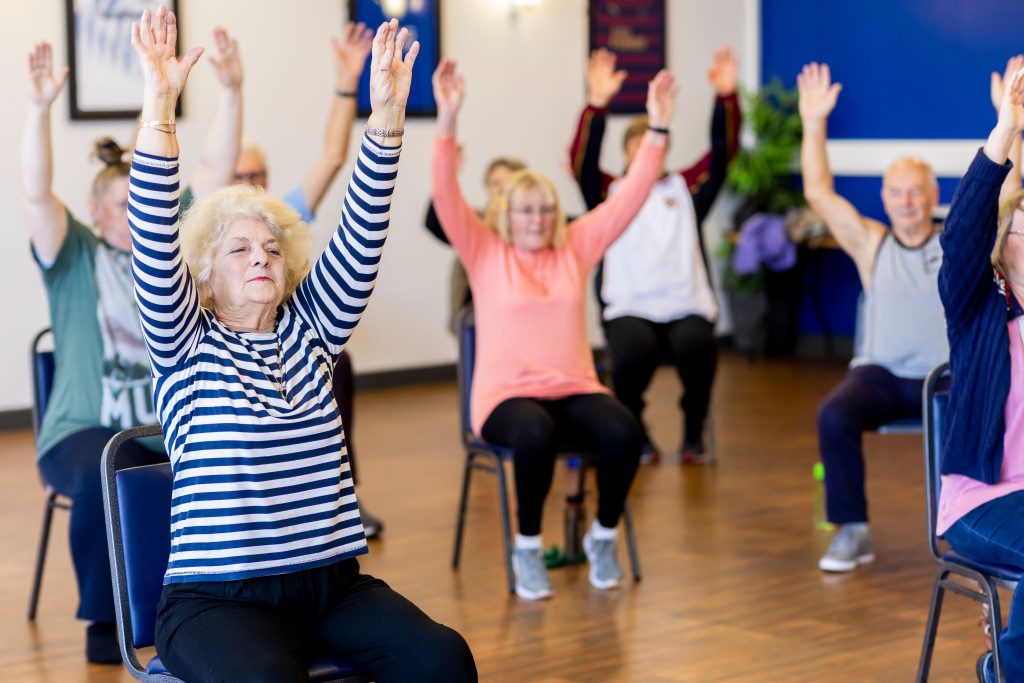
This is written for anyone who exercises sitting down, whether that’s from a dining chair because standing is unsteady, or from a wheelchair because that’s where you live. The exercises overlap almost entirely. The setup doesn’t, so that comes first.
What Counts
Moving your body to whatever extent you can matters more than people assume.
Pushing a manual wheelchair counts as moderate-intensity aerobic activity, the same way brisk walking does. Wheelchair sport counts as vigorous. Resistance bands count as muscle strengthening, and so does adapted yoga.
Moderate means working hard enough to breathe harder, raise your heart rate, and break a sweat. That’s the test, and it doesn’t specify which parts of you are moving.
It also doesn’t have to happen in one block. Thirty minutes across five days, or shorter bursts through the day, count the same. Some activity is better than none, and the people who benefit most from adding a little are the ones currently doing the least.
Set the Chair Up First
The section missing from every chair exercise video, and it differs depending on what you’re sitting in.
If you’re using a regular chair from your house
Sturdy, four legs on the floor, no casters and no wheels. Armrests help for anything involving pushing. Put it against a wall so it can’t slide backward. Feet flat on the floor, and if they don’t reach, use a book or a box rather than letting them dangle. Never use an office chair that swivels or rolls.
If you’re using a manual or electric wheelchair
First things first: make sure you lock the brakes before your attempt at exercise ends up looking like an Evel Knievel stunt gone wrong. Check that your anti-tip bars are in position, because leaning back or pressing overhead shifts your weight rearward. Feet on the footplates or flat on the floor depending on the movement. And know whether your armrests take weight, because some detach or flex, and that’s worth testing at rest rather than mid-set.
Either way, sit properly before you start.
Hips back in the seat rather than slumped forward onto your tailbone. Starting from a slouch trains a slouch.
Warming Up
Five minutes, and it matters more seated because less of your body is moving by default.
Shoulder rolls forward and back. Slow neck turns side to side, no forcing. Arm swings across the body. Gentle trunk rotation if you have the control for it. Then thirty seconds of arms moving continuously overhead and down, which lifts your heart rate before anything loads it.
Strength
Two or more days a week. The standard prescription is eight to twelve repetitions to the point where another one would be genuinely hard, one set to start, building toward two or three.
Shoulder press.
Weights or a band, pressing overhead. Builds what you use for transfers and for reaching high shelves.
Rows.
Band anchored in front, pulling elbows back and squeezing the shoulder blades. The important one, because almost everything else in daily life pushes forward, and this is what keeps the back of your shoulders in the fight.
Bicep curls and triceps extensions.
Straightforward, and the triceps do the work of pushing yourself up out of anything.
Chest press with a band anchored behind you.
Seated push-ups
As long as your armrests and shoulders allow. Hands on the armrests, press down, lift as much of your weight as you can, hold, lower slowly. For wheelchair users, this doubles as pressure relief.
Sit-to-stands, if you can stand safely.
One of the best strength exercises there is for older adults, and a direct predictor of independence. Stand up from the chair without using your hands if possible, sit down under control, repeat. Have something solid nearby and somebody with you the first few times.
Legs, whatever they do.
Seated marching, knee extensions, ankle circles, heel and toe raises. If they don’t move voluntarily, passive range of motion still matters for joints and circulation.
Balance, If You Stand at All
The guidelines single this out for adults over 65, and it’s the component most often skipped, which is unfortunate given that falls are the thing it prevents.
Standing balance work needs a solid surface to hold, a chair behind you, and ideally another person the first few times. Standing with feet together, then heel to toe, then eyes closed if that’s secure. Standing on one foot with a hand on the chair back. Slow weight shifts side to side.
If standing isn’t available, seated balance is still trainable and still worth doing. Sitting unsupported without the backrest, reaching for something beyond arm’s length, turning to look behind you. Anything that makes your trunk work to keep you upright is balance training, and it directly affects transfers and how safe you feel leaning out of a chair.
Core
Harder seated than standing and worth the effort, because trunk stability affects posture, transfers, balance,e and how tired you are by evening.
Seated trunk rotations with hands crossed on the chest, turning side to side. Side bends, reaching toward the floor and returning under control. Forward leans with a controlled return. And straightforward bracing, tightening the abdominal muscles and holding for ten seconds without holding your breath.
There’s more in the piece on why core strength matters and where to start.
Cardio, Seated
The part people assume isn’t available, and it is.
Continuous arm movement is the base. Punching forward alternately, arms overhead and down, wide arm circles, fast small movements. Keep going for two to three minutes at a time rather than stopping every thirty seconds, because sustained effort is what raises your heart rate and holds it there.
Add legs if they work. Seated marching at pace, or alternating heel taps, raises the intensity considerably.
Beyond that: an arm ergometer if you can get to one, pushing a wheelchair on a route with real distance in it, or hand cycling.
The measure is your breathing. If you can still sing, work harder. If you can’t finish a sentence, ease off.
Flexibility
Sitting shortens the front of your body and lengthens the back of it, and that shows up as pain long before anyone connects it to posture.
Chest and shoulder opening matters most. Hands behind your head, elbows drawn back and held. Neck stretches, ear toward shoulder, held rather than bounced. Wrist and finger stretches, which matter more than people expect for anyone gripping a pushrim or a walking frame. And hamstrings and hip flexors if you can reach them or have somebody to help.
Adapted yoga gives this a structure, and that’s covered in the piece on wheelchair yoga and how to do it safely.
The Thing Chair Exercise Content Never Includes
Progression.
Almost every seated workout you’ll find is the same workout forever. Ten reps, light band, cheerful encouragement, no expectation that you’ll be stronger in three months than you are today.
That’s what gives the category away. Progression is how exercise works, and leaving it out says the author doesn’t expect you to improve, which is a particular kind of insult when it’s aimed at older adults, who are told constantly to stay active and rarely told to get stronger.
So progress it. Add repetitions before you add resistance. Move to a heavier band when twelve reps stop being hard. Add a second set, then a third. Slow the lowering phase, which is harder than speeding it up. Add a two-second hold at the point of most tension.
Write down what you did. Not for discipline, for evidence, because seated progress is slow to see in a mirror and easy to see on paper.
If Standing Is Getting Harder
A lot of people reading this are somewhere in the middle. Standing works at home and not at the shops. Short distances are fine, and a car park isn’t. Good days and bad days, and a walking frame that handles one and not the other.
There’s a term for that, and it’s ambulatory wheelchair use. Using a chair some of the time and walking the rest of it.
Most people in that position have never heard the phrase, and they put off using a chair for years, because they’ve absorbed the idea that you have to be unable to walk before you’re allowed one. That belief is wrong,g and it’s expensive. What it costs is conditioning, distance, and eventually the strength that all of this is trying to protect.
Using a chair for the long distances is what preserves your capacity to walk the short ones. It isn’t giving up on the exercise. It’s what makes the exercise worth doing, because you’ve got energy left to do it.
If that sounds like your situation, the piece on what ambulatory wheelchair use actually means is worth reading, including the part about why people get questioned for it.
Safety Worth Knowing
Watch your shoulders.
For wheelchair users,s they’re doing your walking as well as your lifting, and shoulder problems are extremely common over time. That’s the argument for rows and chest stretches rather than only pressing and pushing.
Build in weight shifts if you sit all day.
A session is a good opportunity for pressure relief rather than a reason to skip it.
Breathe.
Holding your breath during exertion spikes blood pressure, which matters more for some people than others.
Stand up slowly if you’re standing at all.
Blood pressure drops on standing are common with age and with several medications, and that’s a fall waiting to happen.
If your injury is at T6 or above
Know the signs of autonomic dysreflexia and stop if they appear. A pounding headache, sweating or flushing above the injury level, or a slowed heart rate during exertion needs attention rather than pushing through.
Reduced sensation changes what you can rely on.
If you can’t feel a joint being overextended, stay well inside your range rather than finding the limit.
Check with somebody first.
Don’t start any new routine without talking to your PCP if you have a cardiac condition, uncontrolled blood pressure, a recent injury, a recent fall, or recent surgery.
Start Smaller Than the Target
A hundred and fifty minutes a week is where you’re heading, not where you begin.
Ten minutes, three times a week, is a real start, and even five minutes produces benefits immediately. What matters more than the number is that it happens again next week, and that it gets harder over time rather than staying the same forever.
The guidelines don’t have a seated tier. Neither should the expectation.